Laser Hair Removal for Hidradenitis Suppurativa: HS Relief
Laser Hair Removal Hidradenitis Suppurativa: Key Takeaways
- Laser hair removal for hidradenitis suppurativa works by targeting the hair follicle, which sits right at the center of what drives HS flares
- Since it disables the follicle through selective photothermolysis, it can reduce the painful nodules, abscesses, and drainage HS causes
- Long-pulsed Nd:YAG has the strongest research behind it, and it’s generally the safest option for medium to dark skin tones
If you live with hidradenitis suppurativa (HS), you know it’s much more than the occasional breakout.
Hidradenitis suppurativa is a chronic inflammatory skin condition that commonly develops in high-friction areas, such as the underarms, groin, and under the breasts.
Since shaving and waxing can worsen irritation and trigger flare-ups, many people wonder whether laser hair removal can help.
Research backs up that interest.
A recent review found that laser treatment significantly improved disease severity across every study included, with only minor side effects, such as mild redness.
In this guide, we will:
- Explain what HS is and why the hair follicle is such a big deal
- Walk through how laser hair removal for hidradenitis suppurativa works, and which lasers are used
- Cover what to expect, aftercare, and how to know if it’s right for you
Hidradenitis Suppurativa Explained
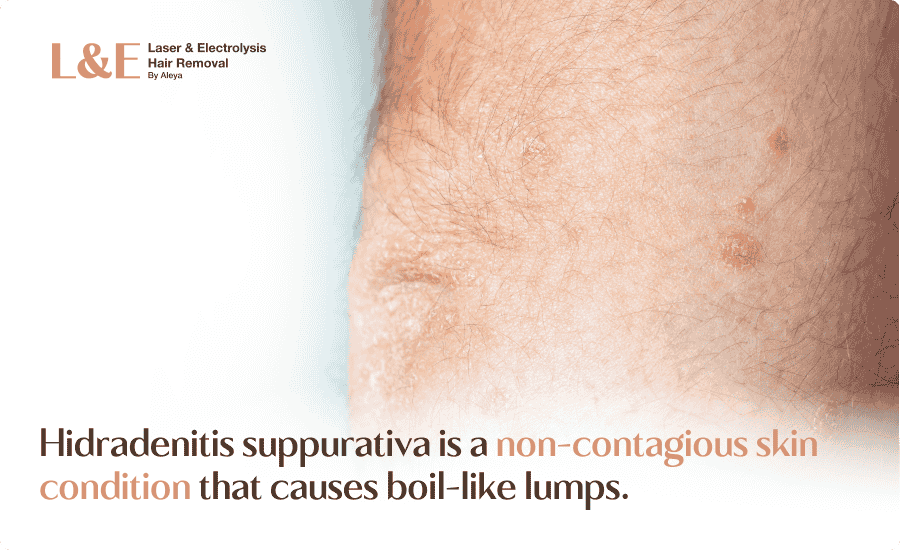
Hidradenitis suppurativa (HS) is a chronic, non-contagious skin condition that causes painful, boil-like lumps, abscesses, and scarring.
HS is often misunderstood, and many people go years before getting a proper diagnosis.
At its core, it starts deep in the hair follicle.
The condition begins when a blockage forms inside the hair follicle, a process called follicular occlusion.
As pressure builds, the follicle ruptures and triggers inflammation in the surrounding skin.
This chain reaction leads to the painful lumps, abscesses, and sinus tracts (tunnels) that are characteristic of HS.
Doctors often describe severity using Hurley stages, from mild and isolated (stage I) to widespread, interconnected tunnels and scarring (stage III).
Knowing your stage helps set realistic expectations for any hidradenitis suppurativa treatment, laser included.
Why Hair Removal Can Be Difficult With Hidradenitis Suppurativa
Here’s the tricky part. Shaving, waxing, and plucking can all irritate already inflamed skin, and sometimes make flare-ups worse.
Waxing and epilating tug at the follicle, the last thing angry, HS-prone skin needs.
Shaving can nick tender areas and introduce bacteria, and even friction from regrowth can set off a flare.
This is exactly why hidradenitis suppurativa hair removal needs a different approach.
Instead of repeatedly triggering the same follicles, laser hair removal helps by reducing the number of active follicles that contribute to future flare-ups.
How Laser Hair Removal Fits Into Hidradenitis Suppurativa Treatment
Laser hair removal for hidradenitis suppurativa works on the root cause.
Thanks to selective photothermolysis, the laser sends targeted energy into the pigment of the follicle and heats it until the follicular unit is disabled.
Fewer active follicles mean less chances for occlusion, rupture, and the inflammation that follows.
In plain terms, you’re shrinking the number of trigger points on your skin!
Research supports these benefits.
A recent study in Lasers in Medical Science reported that people treated with laser hair removal for hidradenitis suppurativa most often experienced:
- Fewer painful lumps
- Less welling
- Reduced flare-ups
Types of Laser Hair Removal for Hidradenitis Suppurativa
Not all lasers play the same game, and the right one depends on your skin tone and hair type.
Here’s a quick look at the lasers most used for hidradenitis suppurativa.
| Laser Type | Wavelength | Best Suited For | Good To Know |
| Long-pulsed Nd:YAG | 1064 nm | Medium to dark skin tones | Its longer wavelength helps protect the surrounding pigment |
| Alexandrite | 755 nm | Light to medium skin | Offers faster treatment sessions thanks to its larger spot size |
| Diode | 800 to 810 nm | A range of skin tones | Balances depth with absorption |
| Intense pulsed light (IPL) | Broad spectrum | Lighter skin | Scatters light, so it’s less targeted than a true laser |
For most people with HS, especially those with darker skin, long-pulsed Nd:YAG is the go-to because its longer wavelength reaches the follicle while protecting the surrounding skin.
Wondering why there are so many laser options? Our guide to laser hair removal devices walks through what makes each one different.
Hidradenitis Suppurativa Treatment: What To Expect During HS Laser Hair Removal
Let’s pull back the curtain. A laser hair removal session is usually faster, and much less intimidating than most folks imagine.
Before the laser comes out, your laser specialist will evaluate your skin tone, hair type, and HS stage to choose settings that safely target the area.
During your laser hair removal, you’ll feel a warm snapping sensation, and many devices use built-in cooling to keep you comfortable.
Sessions are spaced several weeks apart to match your hair growth cycle.
Afterward, mild redness is normal and usually settles within a day or two.
It’s worth reading up on the typical laser hair removal side effects so nothing catches you off guard.
Compared with constantly shaving or waxing inflamed skin, many people find laser hair removal for hidradenitis suppurativa far gentler over time.
Hidradenitis Suppurativa Skin Care Before and After Laser Hair Removal
A little prep goes a long way, helping minimize irritation and support better healing.
- Before your session: Keep the area clean, skip waxing or plucking (shaving is usually fine), and avoid sun exposure and self-tanner. Let your specialist know about any active flares.
- After your session: Stick to fragrance-free cleansers, moisturize, wear loose clothing to cut down on friction, and protect the area from the sun. Give heat, sweaty workouts, and steaming hot showers a short rest for a day or two.
Our full laser hair removal aftercare guide covers this in more detail.
Is Laser Hair Removal Right for Your HS? Consider Laser by Aleya
Here’s the reality check. Laser hair removal can be incredibly helpful, but it doesn’t hand out miracles.
It tends to work best for people with earlier-stage HS, before extensive tunneling and scarring develop, and for those with enough pigment in the hair for the laser to target.
For instance, blonde hair contains less pigment, so results are more limited. In those cases, electrolysis hair removal might be worth discussing.
The other piece of the puzzle is who’s operating the laser.
HS skin can be unpredictable, so settings that work beautifully for one person might be too aggressive for another. Experience matters just as much as the technology.
At Laser by Aleya, Aleya tailors each plan to your skin tone, hair type, and HS stage instead of defaulting to a one-size setting.
Why choose Aleya?
- 20+ years of hands-on experience treating a wide range of skin types, hair patterns, and concerns
- Experience has taught her to read the bigger picture
- She considers everything from hormones to genetics and lifestyle when planning treatments that make sense for each client
If you’ve been wondering whether laser hair removal for hidradenitis suppurativa is right for you, a consultation is the simplest way to find out.
Laser Hair Removal Hidradenitis Suppurativa: FAQs
Does laser hair removal cure hidradenitis suppurativa?
There is currently no cure for this condition.
That said, laser hair removal for hidradenitis suppurativa can significantly decrease flares, pain, and drainage by lowering the number of active follicles, which is why so many specialists now fold it into a broader plan.
How many sessions will I need?
It varies with your skin, hair, and HS stage.
Many people need a series spaced a few weeks apart, and recent patient data points to a median of around eight sessions.
Your laser specialist can map out a timeline, and our guide covers how many laser hair removal sessions most people need.
Will insurance cover it?
It depends.
Coverage varies by insurance plan and location, but laser hair removal for hidradenitis suppurativa might be covered when it’s considered part of your treatment.
It’s a good idea to check with both your provider and insurer to see what’s included.


