Facial Hair Removal for Women: Here’s What Works
Facial Hair Removal for Women: Key Takeaways
- The best facial hair removal method for women depends less on the fanciest laser hair removal device and more on your hair type and skin tone
- Surface methods like shaving and creams last days, waxing and tweezing last weeks, while facial hair laser removal and electrolysis hair removal offer long-term or permanent results
- Most facial hair is simply genetics and hormones doing their thing
- However, a sudden, out-of-pattern change can point to a hormonal cause worth flagging to a healthcare professional
If you’ve spent any time Googling facial hair removal for women, you’ve probably met the internet’s endless supply of “miracle” fixes.
Apparently, everyone seems to have a secret that promises smoother, hair-free skin.
The reality is simpler: the right approach depends on your hair, skin, and what you want from your results.
And if it seems like every other woman has somehow figured this out, rest assured, there was no memo you missed.
A recent study in the Journal of Cosmetic Dermatology notes that unwanted hair is a common cosmetic concern and, for most women, a completely normal part of biology.
That doesn’t mean you have to love it or keep it.
You have options, and choosing to remove it is entirely yours.
In this guide, we’ll:
- Break down what causes facial hair growth
- Compare the main hair removal methods for facial hair
- Explain when it’s worth bringing in a professional, like Aleya
Best Facial Hair Removal for Women: Comparing Your Options
When it comes to finding the best facial hair removal method for women, it really comes down to what matters most to you.
Something quick and easy, weeks of smoother skin, or a more permanent solution to unwanted hair.
Here’s how the options stack up:
| Method | How Long It Lasts | Ideal For | Keep in Mind |
| Shaving | A few days | Quick touch-ups | Needs frequent upkeep |
| Hair removal cream | A few days | Easy at-home removal | May irritate sensitive skin |
| Tweezing | A few weeks | Stray hair strands | Slow for larger areas |
| Threading | A few weeks | Small facial areas | Can feel a little uncomfortable |
| Waxing | A few weeks | Larger areas | Might cause redness |
| Laser hair removal | Long-term reduction | Dark, coarse hair | Takes multiple sessions |
| Electrolysis | Permanent | Any hair color | Takes time, one follicle at a time |
What Causes Facial Hair Growth in Women?
Before you pick a hair removal method, it helps to know what you are removing and why.
A handful of factors do most of the heavy lifting.
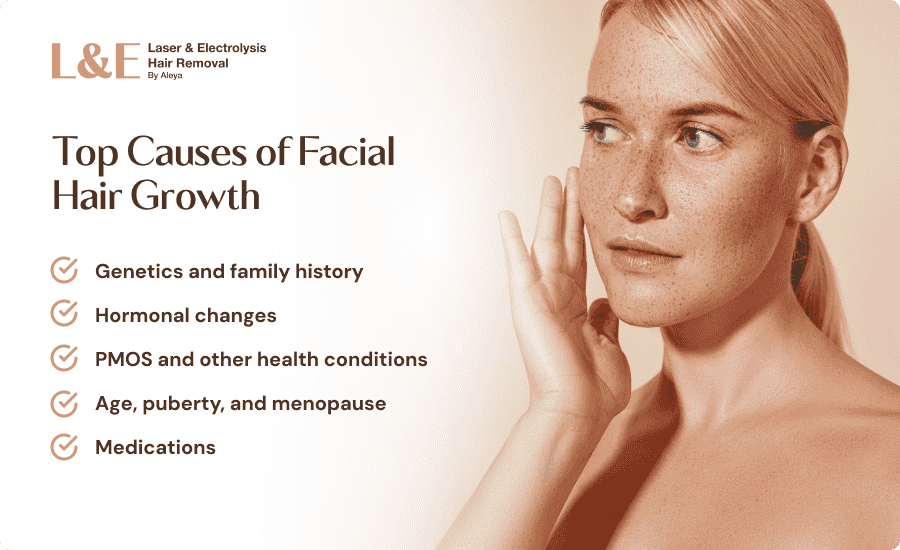
1. Genetics and Family History
Your family tree sets the baseline.
Inherited genes largely decide how many follicles you have, how densely they are packed, and how sensitive they are to hormones.
If the women in your family have always dealt with a stubborn upper lip or a bit of chin hair, yours will very likely follow suit.
2. Hormones, Androgens & DHT
Androgens are the big players here.
Testosterone converts into a more powerful hormone called DHT, which tells your follicles to grow hair that’s thicker, darker, and a little more determined to stick around.
But hormones are only part of the story.
Two women can have identical hormone levels and completely different hair growth, as some follicles are simply more sensitive to those hormonal signals than others.
Think of it as the follicles having their own volume setting.
3. PMOS and Other Health Conditions
Polyendocrine metabolic ovarian syndrome (PMOS), the updated term experts have adopted for what was previously called polycystic ovary syndrome (PCOS), is a common cause of excess facial hair.
And the numbers show just how closely the two are linked.
A recent U.S study of more than 172,000 women found that hirsutism affects about 1.4% of women overall, compared with 19% of women with PCOS.
So, if you’re dealing with PMOS-related hair growth, you’re far from alone.
4. Age, Puberty & Menopause
Hormone levels shift across a lifetime.
Puberty turns fine peach fuzz into coarser terminal hair, and menopause can flip the script again as estrogen drops and androgens gain relative influence.
That’s why facial hair can seem to arrive out of nowhere in your forties or fifties.
5. Medications
Certain medications, including some steroids and hormone therapies, can nudge hair growth into overdrive.
If new growth showed up right after a prescription change, that’s worth mentioning to your doctor.
Knowing the cause is half the battle, as the most effective removal method works best when it is matched to the reason behind the growth rather than chosen at random.
Electrolysis Hair Removal: Permanent Facial Hair Removal for Women
If you want permanent results, electrolysis is the only hair removal method the FDA recognizes as permanent.
It uses a tiny current to disable individual follicles.
This makes electrolysis hair removal effective on all hair colors, including gray and blonde hair that lasers might miss.
Since it targets one follicle at a time, electrolysis is especially ideal for smaller areas like the chin, upper lip, and jawline.
The trade-off is time: permanent results can take up to 12 sessions, depending on how much hair you have and how it grows.
Face Hair Removal for Women: How To Prevent Irritation, Bumps & Ingrown Hair
Any method that tugs, cuts, or dissolves hair can leave skin unhappy if you are careless with it.
Efficient aftercare matters just as much as the hair removal itself.
A few simple habits can keep your skin calm, comfortable, and much less likely to throw a fuss.
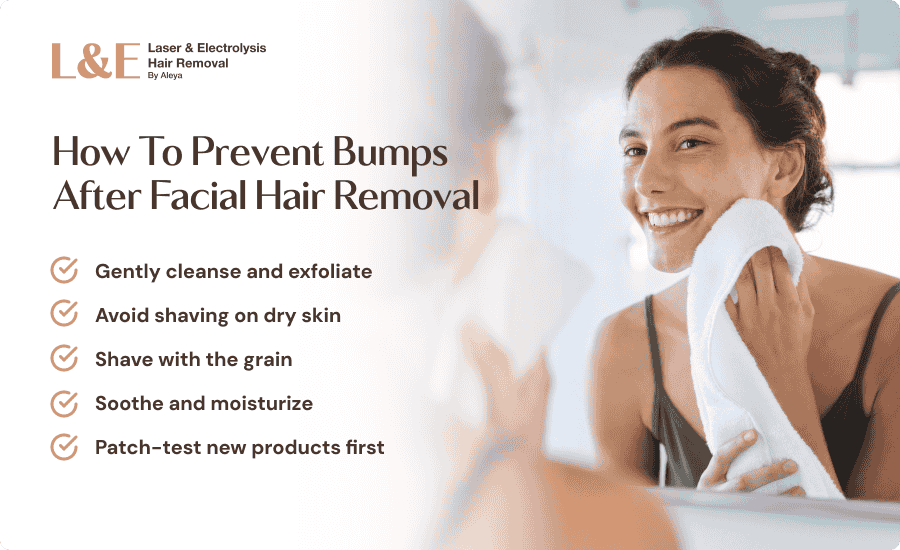
1. Cleanse and Exfoliate Gently
Lightly exfoliating two to three times a week clears dead skin, so new hairs surface cleanly instead of curling back in.
Go gentle, as aggressive scrubbing on freshly treated skin does more harm than good.
2. Never Dry-Shave
If you shave, start with warm water and a lubricating gel or cream to help the blade glide smoothly.
Shaving dry skin creates unnecessary friction, which can lead to nicks, redness, and razor bumps.
3. Go With the Grain, Not Against It
Removing hair in the direction it grows is gentler on the follicle and cuts down on ingrown hairs.
It might feel less “close,” but your skin will thank you.
4. Soothe and Moisturize After
Follow any removal method with a fragrance-free moisturizer or a calming gel like aloe.
Keeping the skin barrier happy is the difference between smooth and blotchy.
5. Patch-Test New Products
Whether it is a new cream, wax, or serum, test it on a small patch first and wait 24 hours.
Facial skin is thinner and more reactive than the skin on your legs.
For laser clients specifically, protecting your skin barrier also lowers the risk of post-treatment hyperpigmentation, especially on darker skin tones.
Get Lasting Facial Hair Removal For Women at Laser by Aleya
Here’s the honest truth: the best facial hair removal method isn’t necessarily the newest or most expensive option.
It’s the one that works with your skin tone, hair type, growth pattern, and long-term goals.
There’s a reason Laser by Aleya offers both laser and electrolysis: not every hair needs the same treatment.
With more than 20 years of experience, Aleya knows when laser can do the heavy lifting, when electrolysis makes more sense, and when combining the two can get you closer to the result you want.
Facial Hair Removal for Women: FAQs
What is the best facial hair removal for women with sensitive skin?
Gentler methods are usually more ideal for sensitive skin.
Threading and face-safe creams offer temporary results, while professionally performed laser hair removal and electrolysis can reduce the irritation that comes with frequent hair removal.
Just remember to always patch-test new products first.
Is facial hair removal for women ever truly permanent?
Electrolysis hair removal is the only method recognized as permanent.
Laser hair removal provides long-term hair reduction, while shaving, creams, waxing, and threading offer temporary results.
Does a facial hair removal cream for women actually work?
Yes, but results are short-lived.
Facial hair removal creams dissolve hair at the skin’s surface, with results typically lasting a few days.
Choose a face-safe formula and stop if you experience stinging or irritation.
How do I choose the best facial hair removal method for my face?
Consider the treatment area and your goal.
Tweezing, threading, and electrolysis work well for small, precise areas, while laser hair removal is better suited to larger areas and long-term reduction.


