Why Does Facial Hair Grow So Fast? Here’s the Truth
Why Does Facial Hair Grow So Fast? Key Takeaways
- Fast-growing facial hair comes down to your genes and hormones
- Coarse, dark hairs show up the moment they clear the skin, and shaving only cuts at the surface, so regrowth feels quick even though nothing about the growth rate changed
- Some facial hair is completely normal, but a rapid, out-of-pattern change, can point to a hormonal cause worth discussing with a healthcare specialist
If you want the real reason behind “why does facial hair grow so fast?”, it helps to start with what’s happening beneath the skin.
Every hair on your body moves through a repeating cycle, and the length of each stage is what decides how long and how fast a hair grows.
A recent review of hair follicle growth shows just how tightly this process is genetically programmed.
Facial, scalp, and body hair all run the same three stages on different clocks, and that timing is a big part of why facial hair grows fast.
In this guide, we will:
- Answer “why does facial hair grow so fast?”
- Cover what causes facial hair to grow faster than usual?
- Tips on how to slow down facial hair growth
Why Does Facial Hair Grow So Fast?
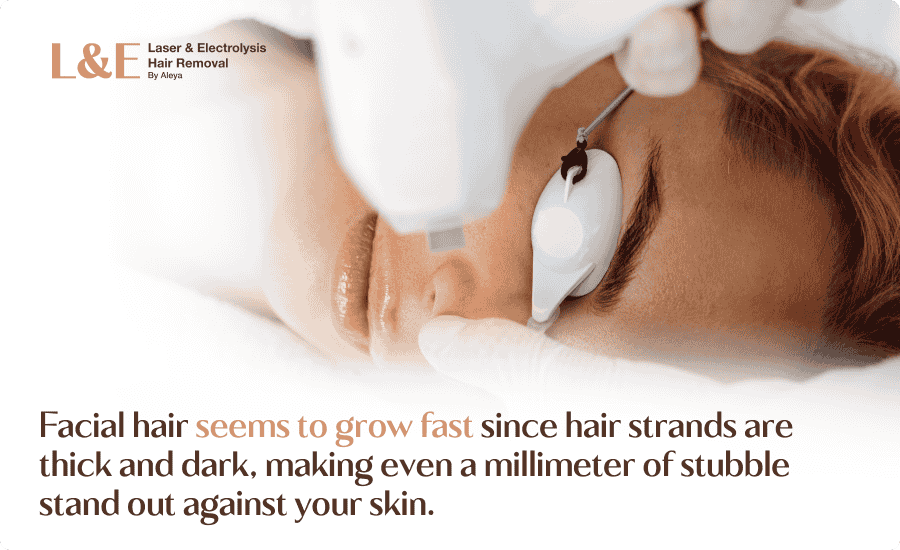
Facial hair feels quick to grow because the hair strands are thick and pigmented, so even a millimeter of regrowth stands out sharply against your skin.
Hormones (especially androgens) and inherited follicle sensitivity set your baseline pace, while shaving simply resets the visible starting line.
Coarse, dark stubble shows as soon as it clears the skin, so a clean-shaven jaw can look shadowed again by evening even though the hair isn’t growing any faster.
What Is Considered Normal?
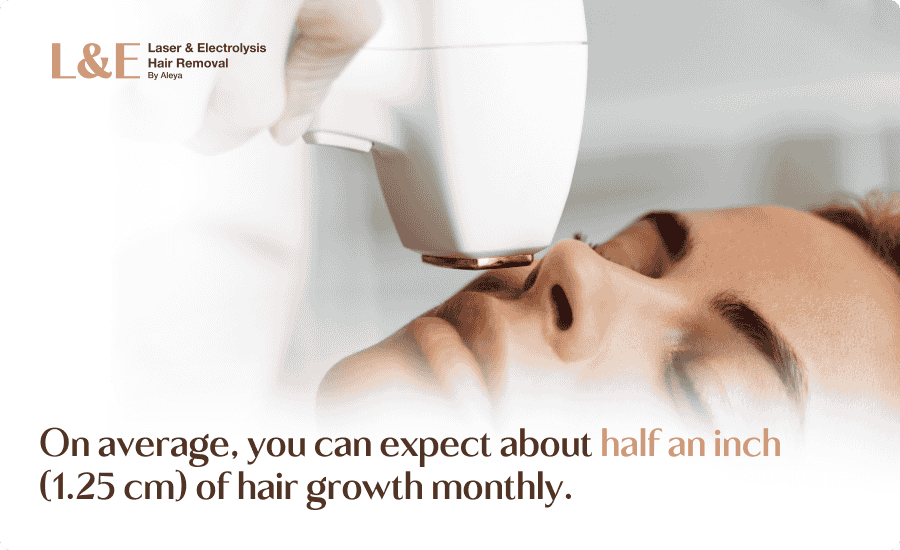
On average, hair grows roughly half an inch (about 1.25 cm) a month, but facial follicles vary widely from one person to the next, and even from cheek to chin.
Some folks see daily stubble while others shave twice a week, and both are perfectly normal.
What actually matters is a steady pattern: a sudden, dramatic change is the part worth paying attention to.
How the Facial Hair Growth Cycle Works
The three-stage life of a facial hair looks like this:
Anagen: The Active Growth Phase
Anagen is the growth stage, when the follicle actively pushes out a hair shaft.
Scalp hairs can stay in anagen for two to seven years on average, which is exactly why the hair on your head grows long.
Facial, leg, and body hairs have a shorter anagen phase, often weeks to a few months, so they reach a set length and stop rather than growing indefinitely.
Catagen: The Transition Phase
Catagen is a brief wind-down of about two to three weeks.
Growth halts, the follicle shrinks, and the hair detaches from its blood supply.
It’s a small slice of the overall cycle, but it’s the hinge between growing and resting.
Telogen: The Resting and Shedding Phase
Telogen is where the follicle clocks out for a while.
The old hair stays anchored in place while a new one prepares underneath, and eventually the old hair sheds so the cycle can start again.
Since your follicles aren’t synchronized, some are always growing while others rest, which is why facial hair seems to reappear on a rolling, never-quite-finished basis.
What Causes Facial Hair To Grow Faster Than Usual?
If you’re still asking, “Why does facial hair grow so fast?” a handful of factors do most of the heavy lifting.
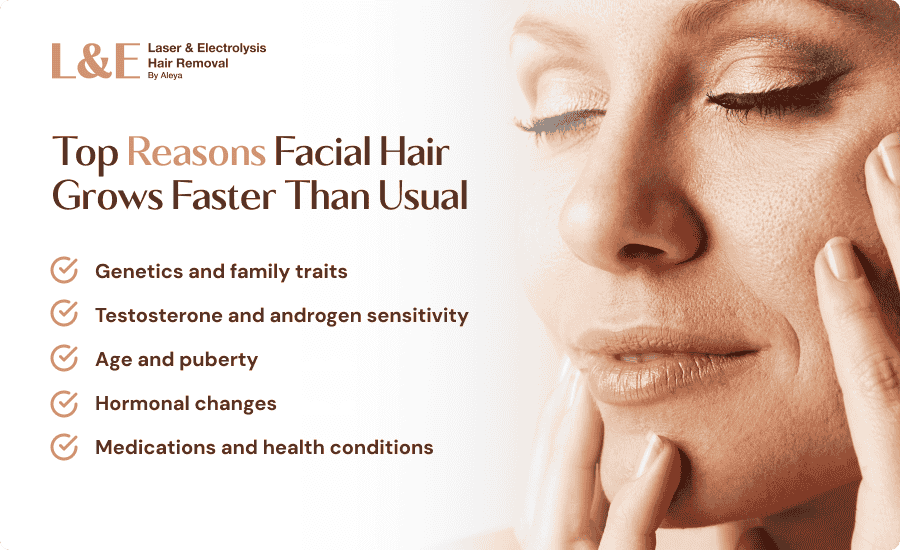
1. Genetics and Family Traits
Your family tree sets the template.
Inherited genes largely decide how many follicles you have, how densely they’re packed, and how sensitive they are to hormones.
If thick facial hair runs in your family, yours very likely will too.
2. Testosterone, DHT & Androgen Sensitivity
Androgens are the main drivers here.
Testosterone converts into a more potent hormone called DHT, and research on how DHT acts on hair follicles shows it binds to follicle receptors far more strongly than testosterone does.
However, hormonal levels are only half the story.
How sensitive your follicles are to those hormones matters just as much, which is why two people with identical testosterone can grow completely different beards.
3. Age and Puberty
Facial hair ramps up during puberty as androgen levels climb, transforming fine “peach fuzz” (vellus hair) into thicker, darker terminal hair.
For many people, facial hair keeps thickening and spreading well into their twenties and beyond.
4. Hormonal Changes
Pregnancy, menopause, or anything that raises androgen levels can shift where and how fast hair grows.
That’s usually the reason facial hair speeds up seemingly overnight.
5. Medications and Health Conditions
Certain medications, such as steroids and hormone therapies, along with conditions like polyendocrine metabolic ovarian syndrome (PMOS), can increase hair growth.
If growth changes sharply or arrives with other symptoms, that’s worth a conversation with your endocrinologist.
Why Does My Leg Hair and Pubic Hair Grow So Fast?
Different areas of the body run on different clocks.
If you’ve wondered, “why does my leg hair grow so fast,” it usually comes down to contrast and cycle length.
Leg hair tends to be darker than the surrounding skin and has a short growth phase, so it reaches its length and gets noticed quickly.
However, pubic hair works differently, mostly because those follicles are especially androgen-sensitive and turn coarse and dark early in puberty.
In short, facial, leg, and pubic hair each respond to hormones and follow their own timeline.
The Real Deal on How To Slow Down Facial Hair Growth
Let’s be honest about what’s possible: most at-home hair removal methods remove or hide hair rather than changing how fast it grows.
A few approaches worth knowing include:
- Gentle skincare and light exfoliation keep the area smooth and cut down on ingrown hairs, though they won’t slow growth itself
- Longer-lasting removal methods stretch out the time between touch-ups
- Doctor-prescribed treatments, like hormone-regulating medication or a prescription cream, target the growth directly when a hormonal cause is driving it
Hair Removal Options: What’s the Best Way To Handle Fast Regrowth?
If fast regrowth has you reaching for the razor every morning, here’s how the most common hair removal methods stack up.
| Method | How Long Results Last | Removes at Surface or Follicle | Irritation Risk | Is It Safe for the Face? |
| Shaving | 1–3 days | Surface | Low to moderate | Yes; quick daily upkeep |
| Trimming | 1–3 days | Surface | Very low | Yes; softens rather than removes |
| Tweezing | 3–8 weeks | Follicle | Moderate | Ideal for small areas like the brows |
| Threading | 2-5 weeks | Follicle | Low to moderate | Yes; popular for brows and the upper lip |
| Waxing | 3–6 weeks | Follicle | Moderate to high | Yes, but do a patch test first |
| Depilatory creams | Up to one week | Surface | Moderate | Only if the product is labeled safe |
| Laser hair removal | 6-8 weeks | Follicle | Moderate | Yes, with the right type of laser hair removal device |
| Electrolysis hair removal | Permanent results | Follicle | Moderate | Yes; works on any hair color and suits small facial areas |
When Rapid Facial Hair Growth Might Need Medical Advice
Gradual facial hair development is usually just biology doing its thing.
But growth that comes on suddenly, spreads quickly, or turns unusually coarse can sometimes point to a hormonal issue worth checking.
Clinical guidance on excess hair growth notes that a rapid or out-of-pattern change deserves evaluation, especially alongside other signs.
Watch for menstrual changes, severe or sudden acne, scalp hair thinning, a deepening voice, or growth that started right after a new medication.
Get Facial Hair Regrowth Under Control at Laser by Aleya
Facial hair growth is something of a personal signature: it runs on a schedule set mostly by your genetics, hormones, follicle sensitivity, and age.
So, when people ask “why does facial hair grow so fast?”, the honest answer is that “fast” is relative.
When facial hair keeps coming back faster than you’d like, the right plan matters more than the fanciest machine.
At Laser by Aleya, Aleya builds every treatment around your skin tone, hair type, and growth pattern, because no two heads of hair behave the same way.
Here’s why clients trust Aleya:
- More than 20 years of hands-on experience across a wide range of skin tones, hair textures, and growth patterns
- A trained eye for the bigger picture, not just the hair in front of her
- A plan that accounts for the real drivers of regrowth, from hormones and genetics to lifestyle, so your results hold
Why Does Facial Hair Grow So Fast? FAQs
Why does facial hair grow so fast all of a sudden?
A sudden change is usually tied to hormones, whether puberty, pregnancy, menopause, a new medication, or a condition that raises androgen levels.
Does shaving make facial hair grow faster?
No. Shaving cuts hair at the surface and never reaches the follicle, so it can’t change your growth rate, hair color, or true thickness.
Regrowth only feels coarser because the blunt, shaved tip lacks the soft, tapered end of an uncut hair.
Why does my leg hair grow so fast?
Leg hair often seems to grow fast for two reasons: it’s darker than the surrounding skin, so it’s easy to spot, and it moves through a short growth phase, so it reaches its full length quickly.
Genetics and hormones set the actual pace, and shaving just makes that regrowth obvious sooner.
Why does my pubic hair grow so fast?
Pubic hair follicles are highly sensitive to androgens, so they develop thick, coarse terminal hair early and keep a noticeable growth pattern.
The hair is also curly and dark, which makes even short regrowth stand out against the skin far more than finer body hair does.
Does fast facial hair growth mean high testosterone?
Not necessarily.
Follicle sensitivity matters as much as hormone levels, so people with perfectly normal testosterone can still grow hair quickly.
That said, a sudden jump in growth alongside other symptoms can sometimes reflect a hormonal imbalance that’s worth a medical evaluation.


