Perifollicular Edema: Why Skin Swells After Laser Hair Removal
Perifollicular Edema: Key Takeaways
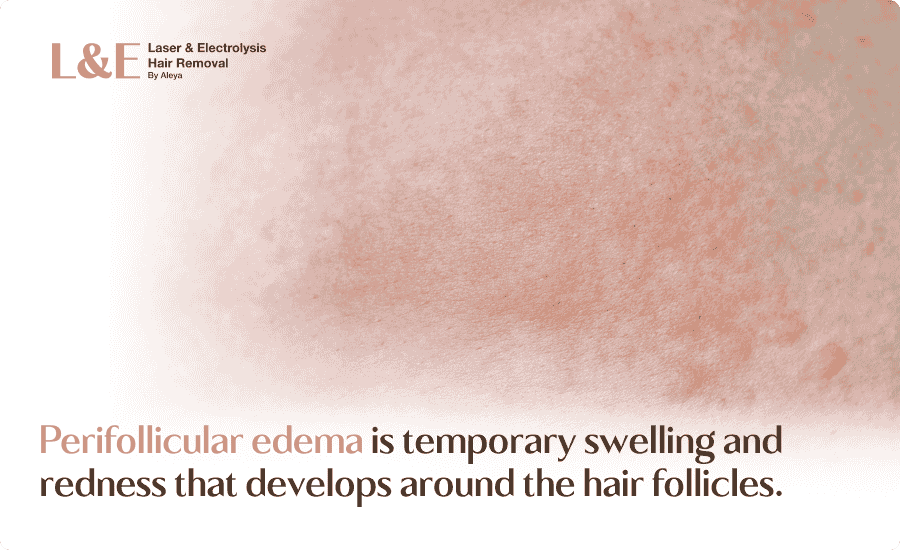
- Perifollicular edema is that small, puffy swelling that might show up around each treated follicle right after your laser hair removal session
- Mild redness and swelling after laser hair removal usually settle within hours to a couple of days
- Not every bump after laser hair removal is perifollicular edema. Folliculitis, ingrown hairs, and a histamine-style rash can look similar but need different care.
If your skin puffed up into a field of tiny bumps minutes after treatment, congratulations, your follicles got the memo.
It looks dramatic, but it’s rarely a cause for alarm.
Take a breath, because you’re most likely looking at perifollicular edema, and it’s one of the most common (and most harmless) things laser hair removal can do.
In fact, a recent clinical study following patients through a full laser course found that transient side effects like perifollicular edema tend to resolve within days.
In this guide, we will:
- Break down why your skin swells after laser hair removal, and why it’s usually normal
- Show you what those bumps after laser hair removal look like (and how to tell them apart)
- Explain how Aleya helps keep skin conditions in check, including hidradenitis suppurativa
Understanding Perifollicular Edema
Perifollicular edema is a mouthful, so let’s take it apart: “peri” means around, “follicular” refers to your hair follicles, and “edema” is just the medical word for swelling.
Put it together and the result is the mild swelling that forms in a ring around each hair follicle after it’s treated.
On the skin, it shows up as a slightly raised, puffy halo circling the pore, which is why treated areas can look and feel a bit like goosebumps that won’t go back down.
It’s one of the clearest signs the laser’s energy reached the follicle.
On its own, though, it says nothing about how well your treatment “worked,” which is a laser hair removal myth worth clearing up early.
Why Does Skin Swell After Laser Hair Removal?
Laser hair removal runs on a principle called selective photothermolysis.
Think of it as a fancy way of saying the laser’s light is tuned to be absorbed by the pigment (melanin) in your hair rather than by your skin.
When that pigment soaks up the energy, it heats the hair shaft and the follicle wrapped around it.
A recent review of the laser hair removal literature confirms selective photothermolysis is still the backbone of how modern devices target hair while sparing the skin around it.
That burst of controlled heat is the entire point of the treatment.
But your skin treats it like any other irritant:
- Blood vessels around the follicle widen
- Fluid seeps into the surrounding tissue
- You get the localized redness and swelling after laser hair removal that we call perifollicular edema
Is Perifollicular Edema a Normal Laser Reaction?
Typically, yes.
Mild, short-lived redness and swelling after laser hair removal are expected, and this puffiness is one of the most common versions of that reaction.
But “usually normal” doesn’t always mean there’s nothing to worry about, so it’s important to know when it might need attention.
Expected Post-Laser Symptoms
In the first few minutes to hours, it’s normal to notice mild laser hair removal side effects like warmth, mild tenderness, and that raised, puffy feeling around each follicle.
Think of it like a low-grade sunburn that gradually settles over the next few hours to a few days.
Mild Reactions vs. Complications
The difference comes down to severity. Mild reactions feel like a light sunburn and improve by the hour.
Complications get worse instead of better: blistering, burns, spreading redness, oozing or crusting, or pain that ramps up over time.
Those aren’t symptoms to wave off as “just perifollicular edema.”
Reactions in that camp, along with anything that risks scarring, are your signal to stop guessing and check in with your laser specialist.
Does Everyone Experience Follicular Swelling?
Not necessarily. Some follicles make their feelings known with a little redness and puffiness, while others barely react.
How noticeable it gets can depend on your hair, treatment area, laser settings, and your skin’s individual response.
What Do Bumps After Laser Hair Removal Look Like?
Classic perifollicular edema looks like a spray of tiny, closely spaced bumps; each one centered squarely on a treated follicle.
Picture faint goosebumps or a light patch of hives that follow the exact pattern of your hair.
But not every bump after laser hair removal is perifollicular edema, and telling them apart saves you a lot of worry:
| Reaction | What It Looks Like | Where It Shows Up | When It Appears | How It Feels | How Long It Lasts |
| Perifollicular edema | Tiny, even puffy bumps, like faint goosebumps | On each treated follicle | Within minutes of your session | Warm, maybe a little tender, and rarely itchy | A few hours to 2–3 days |
| Folliculitis | Red or white-tipped bumps, some pus-filled | On the follicles but often patchy | Usually a day or two later | Itchy, tender, and sometimes sore | Up to 10 days |
| Hives | Smooth, raised welts of varying size | Anywhere, even well past the treated follicles | Minutes to an hour or two | Really itchy | Individual welts come and go within hours |
| Rash | A broader patch of redness, sometimes flaky | Spread across the area, in between follicles | Hours to a day or two | Itchy | A few days; longer if something keeps irritating it |
How Long Do Redness and Swelling Last?
For most people, redness after laser hair removal and the puffiness of perifollicular edema fade within a few hours to two or three days.
That’s not just us being reassuring, either.
The rotational-laser study we mentioned earlier saw the same thing: redness and perifollicular edema packed up and left within a few days.
And when a separate study on the 755 nm Alexandrite laser kept close tabs on how people’s skin reacted, it landed in the same place, with reactions that stayed mild and didn’t last.
How To Soothe Skin Irritation and Bumps After Laser Hair Removal
You can’t rush the swelling off your skin, but you can keep things calm while it settles.
Here’s how to ease skin irritation after laser hair removal without slowing your recovery:
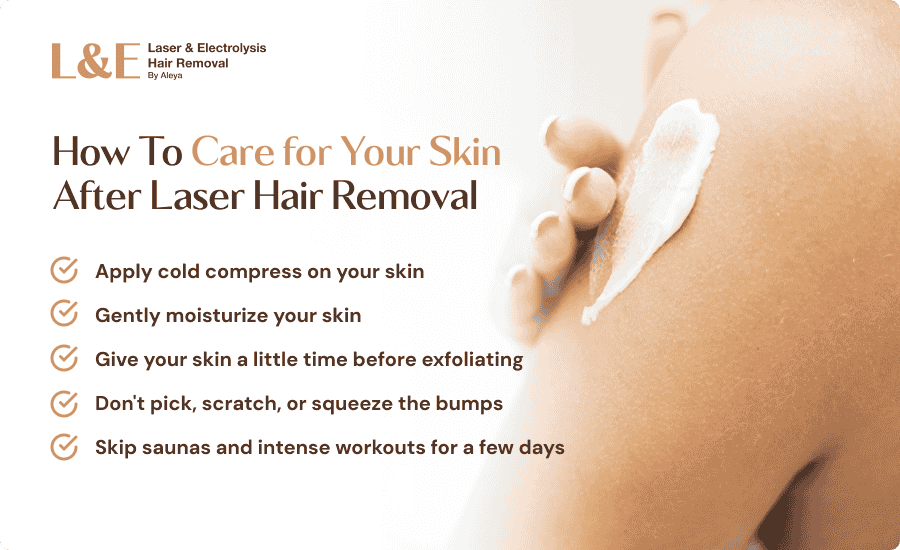
- Cool it down: A cold compress (or a cloth-wrapped ice pack) for a few minutes at a time eases the heat. Keep water lukewarm and skip hot showers for the first day.
- Moisturize gently: Reach for a fragrance-free moisturizer with aloe, ceramides, or hyaluronic acid. Skip anything with alcohol or fragrance that stings.
- Hands off: Don’t pick, scratch, or squeeze the bumps, no matter how tempting it is. Doing so can turn mild irritation into folliculitis or even leave a scar.
- Skip the heat: Give saunas, hot tubs, and intense workouts a day or two off, since sweat and friction feed the irritation.
- Wait to exfoliate: Once the area feels normal again, gentle exfoliation can help with hair shedding.
- Soothe, don’t overtreat: Aloe and cool compresses are usually plenty. For a spot that feels genuinely tender, these tips for soothing a laser burn can help you tell comfort care from “call the clinic.”
Manage Perifollicular Edema at Laser by Aleya
A little swelling is normal, but how much you swell (and how fast you bounce back) has a lot to do with who’s holding the laser.
At Laser by Aleya, Aleya builds every session around your skin tone, hair type, and how your skin has reacted before, because no two people puff up the same way.
Here’s why clients trust Aleya:
- She has more than 20 years of hands-on experience across a wide range of skin tones and hair textures
- She utilizes laser devices that gets tuned to you, not to some factory default, which is half the reason your skin stays calmer
- She follows a straightforward prep guidance, like why shaving before your session matters, so you start each treatment on the right foot
Perifollicular Edema: FAQs
Is perifollicular edema normal after laser hair removal?
Yes. Mild, follicle-centered swelling that fades within hours to a few days is a normal, expected reaction.
Swelling that spreads, worsens, or comes with blistering is not, and that’s worth a call.
Are bumps after laser hair removal normal?
Tiny bumps ringing each follicle are common and temporary, and a little skin irritation after laser hair removal usually comes with the territory.
On the other hand, pus-filled, painful, or spreading bumps after laser hair removal deserve a closer look from your healthcare provider.
Can laser hair removal cause folliculitis?
It can. The heat can inflame follicles, and bacteria entering freshly opened pores can tip that into folliculitis.
It’s typically mild and clears on its own, but persistent or pus-filled bumps might need treatment.
Why do I have hives after laser hair removal?
Hives after laser hair removal are usually a histamine reaction, essentially a rash after laser hair removal rather than real perifollicular edema.
Cool compresses and an over-the-counter antihistamine often calm it, and if it spreads or won’t quit, contact your healthcare provider.
How long does redness after laser hair removal last?
For most people, a few hours to two or three days.
Redness after laser hair removal that lingers well beyond that, or gets worse instead of better, is worth flagging to your laser specialist.


