Laser Hair Removal Shedding: What To Expect & FAQs
Laser Hair Removal Shedding Explained: Key Takeaways
- After laser hair removal, shedding is your body’s way of clearing out treated hair
- Laser hair removal shedding can take up to three weeks and often happens unevenly
- To reinforce shedding, exfoliate lightly after two to three days, moisturize daily, and avoid tweezing or picking
If you get laser hair removal, you might notice some shedding.
Before you panic, know that it’s normal since your body is simply pushing out the treated hairs.
While it might feel like everything’s growing back, it’s usually not the case.
In fact, according to The Trichological Society, hair grows about 0.5 to 1.7 centimeters per month on average; that’s roughly 0.2 to 0.7 inches.
In this guide, we will:
- Explain why shedding occurs after laser hair removal
- Share what laser hair removal shedding looks like
- Cover tips on how to encourage proper laser hair removal shedding, without irritating your skin
- Discover how Aleya makes the process smoother, safer, and more effective
Why Does Shedding Occur After Laser Hair Removal?
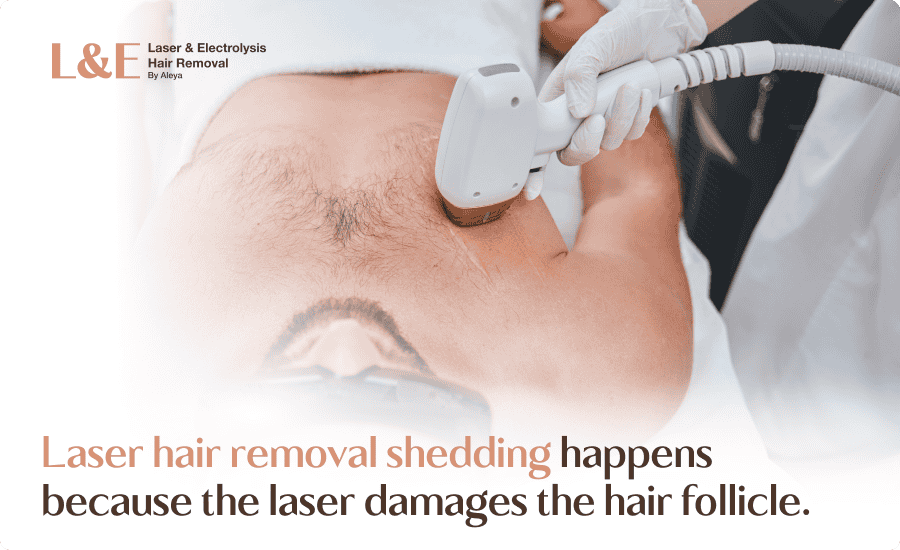
Shedding happens after laser hair removal because the laser damages the hair follicle, slowing down future growth.
The treated hair is then pushed out of the skin over the following days or weeks, as this is your body’s way of releasing hair that’s no longer supported by an active follicle.
Laser Hair Removal Shedding: What It Looks Like
After a laser hair removal session, it might look like your hair is growing back, but what’s actually happening is shedding.
This is totally normal and a good sign that the treatment is working.
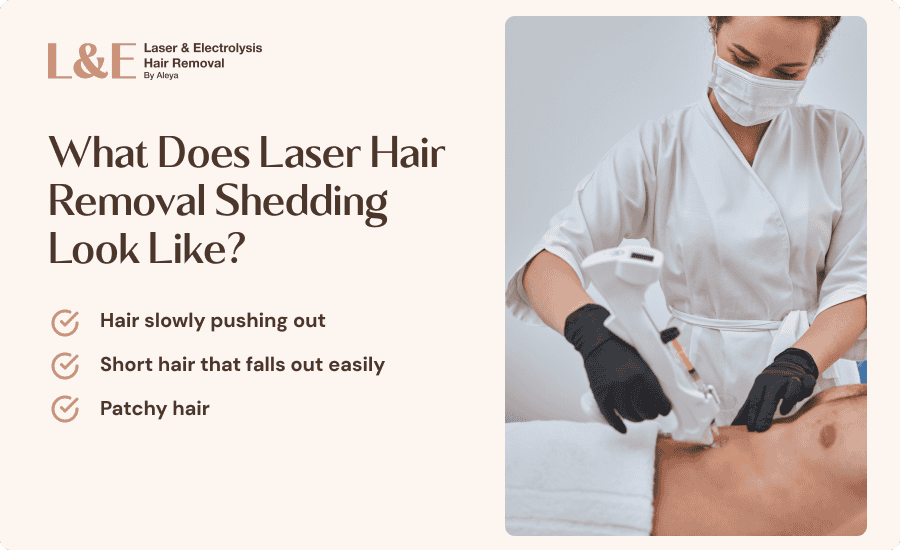
You might notice the following:
- Hair slowly pushing out over the next one to three weeks
- Stubble or short hairs that fall out easily in the shower or when you exfoliate gently
- Patchy areas, where some hairs are gone and others are still shedding
4 Stages of Hair Growth
Hair grows in four stages: anagen (growth), catagen (transition), telogen (rest), and exogen (shedding).
Understanding these phases can help make sense of why laser hair removal takes multiple sessions.
1. Anagen: The Active Growing Phase
The anagen phase is your hair’s active growth period. During this time, follicles produce new strands that push through the skin.
On your scalp, this phase can last two to eight years, which is why head hair grows long.
In contrast, brows, lashes, and pubic hair have much shorter growth phases and stop growing sooner.
At any given moment, about 85% to 90% of the hairs on your head are in this growth phase.
This is also the phase where treatments like laser hair removal or electrolysis are most effective because the root is fully attached and active.
2. Catagen: The Transition Phase
After your hair finishes growing, it moves into the catagen phase.
This is a short window, usually just about two weeks, where the hair stops growing and begins to detach from the blood supply.
During the catagen phase, the follicle shrinks and the hair detaches from its blood supply.
While it’s no longer growing, the hair remains in place just beneath the skin.
At any given time, only about 1% to 3% of your hair is in this short transition phase.
3. Telogen: The Resting Phase
Next up is the telogen phase; this is when the follicle takes a little break.
Hair stays in this stage for roughly two to three months.
It’s not growing, but it’s not falling out yet, either. Roughly 9% of your scalp hairs are in this resting phase at any moment.
While this phase is happening, your body is quietly working on forming new hair beneath the surface, getting ready to push out the old strand.
4. Exogen: The Shedding Phase
The exogen phase is when your hair naturally sheds to make room for new growth.
You might see strands in your brush, on your pillow, or in the shower, and this is completely normal.
Most people lose 50 to 100 hairs a day during this phase.
While it might seem like a lot, it’s just part of your body’s regular cycle.
Behind the scenes, new hairs are already forming and preparing to take their place.
How Much Does Hair Grow in a Month?
Hair grows about 0.5 to 1.7 cm per month (0.2 to 0.7 inches), which is why results from laser hair removal take time.
Any regrowth you see between sessions is likely from untreated follicles just entering the growth phase.
When Laser Hair Removal Shedding Isn’t Normal: Signs To Watch For
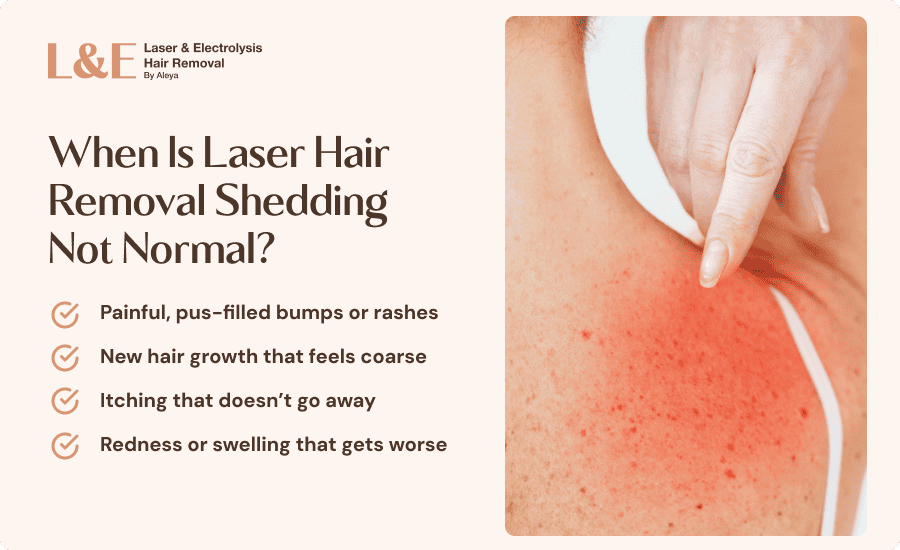
While light shedding is totally normal after laser hair removal, there are a few red flags to keep an eye on.
These could indicate irritation, infection, or that the treatment wasn’t fully effective.
If something feels off, look for:
- New hair growth that feels coarse or unchanged
- Itching that doesn’t go away or gets more intense
- Redness or swelling that gets worse after 24–48 hours
- Hair that doesn’t shed at all after two to three weeks
How To Encourage Proper Laser Hair Removal Shedding (Without Sabotaging Your Skin)
Shedding is a normal and expected part of the laser hair removal process, but it does require some gentle support and a bit of patience.
Here’s how to help the process along while keeping your skin happy:
1. Start Exfoliating Gently After 48 to 72 Hours
Think of it as a nudge, not a scrub. Use a soft washcloth, sugar scrub, or exfoliating mitt to help loosen those treated hairs.
Don’t be tempted to go overboard because your skin is still healing.
2. Moisturize Like Your Life Depends on It
Hydrated skin sheds more easily and feels way better.
Use a fragrance-free lotion or aloe gel daily to soothe and support healthy turnover. Bonus tip: it helps keep itchiness and flaking at bay.
3. Hands Off the Tweezers (and Wax Strips)
We know it’s tempting, but pulling hair out manually can mess with your results.
The laser already disabled the follicles, so let those dead hair strands fall out naturally.
4. No Picking Even if It’s Satisfying
Shedding hair strands can look like they’re “stuck,” but resist the urge to pluck.
Picking can lead to irritation, ingrown hair, or even small scars. Trust the process; your skin knows what it’s doing!
5. Stay Cool and Skip the Hot Stuff
For the first few days, avoid hot showers, saunas, or intense workouts.
Heat can make your skin more sensitive and slow healing (plus, who wants to walk around looking sunburned?).
6. It’s a Slow Burn, but It Works
Shedding doesn’t happen right away. It can take up to three weeks and it won’t all fall out at once.
If you’re seeing patchy hair loss, that’s actually a good thing.
It means the laser did its job and your body is clearing out the treated hair.
Safe, Effective Laser Hair Removal Starts at Laser by Aleya
At Laser by Aleya, you’re never just another appointment to us; you’re a person with real goals and real concerns.
We specialize in personalized laser treatments that are tailored to your hair type, skin tone, and comfort level.
With Aleya, you don’t have to worry about outdated equipment or inconsistent results.
Our team uses top-tier tech like the Lumenis Diode LightSheer, a powerful system that’s safe for most skin tones and seriously good at kicking unwanted hair to the curb.
Laser Hair Removal Shedding: FAQs
Laser hair removal shedding vs. normal hair growth: what’s the difference?
Shedding after laser hair removal is when treated hairs are pushed out of the skin because their follicles have been disabled.
In contrast, normal hair growth comes from active follicles producing new strands.
What does shedding look like after laser hair removal?
Shedding after laser hair removal often looks like tiny, stubbly hairs coming to the surface, then falling out on their own.
You might see them come off in the shower, on your pillow, or when you gently exfoliate or rub the area.
Is it okay to shave while I’m shedding?
Yes! Shaving is totally fine during the shedding phase.
Just avoid waxing, plucking, or threading, since those can disrupt the follicle and reduce the laser’s effectiveness.
If you do shave, be gentle and use a clean, sharp razor to avoid irritation.
What if I don’t see any shedding after my laser hair removal session?
If you don’t notice any shedding within a few weeks, it doesn’t necessarily mean the treatment didn’t work.
Sometimes the hair strands are finer or fall out gradually that it’s easy to miss.
However, if you’re concerned or unsure, it’s always a good idea to check in with your laser specialist for a quick follow-up.

![Laser Hair Removal Areas: A Side-by-Side Comparison [+ FAQs]](https://www.laserbyaleya.com/wp-content/uploads/2026/02/laser-hair-removal-areas-hero-image-768x469.png)